
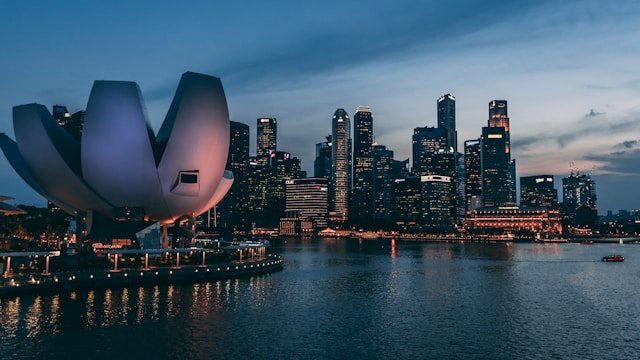
1. The Anchor of Global Trade and Supply Chains
At its core, Singapore is the heartbeat of Indo-Pacific trade. The Port of Singapore consistently ranks as one of the busiest and most efficient container transshipment hubs on the planet, connecting over 600 ports across more than 120 countries.
-
Strategic Maritime Crossroads: Controlling access to critical trade routes means Singapore is vital to global supply chain resilience.
-
World-Class Logistics: Beyond physical shipping, Changi Airport functions as a top-tier air cargo hub, integrating sea-to-air multimodal logistics seamlessly.
-
Pro-Business Infrastructure: Free trade agreements, minimal tariff barriers, and streamlined customs processes make doing business remarkably frictionless.
When global supply chains face disruption, Singapore’s efficiency acts as a stabilizing shock absorber for international markets.
2. Financial Citadel of Asia
Over the last few decades, Singapore has evolved into the undisputed financial capital of Southeast Asia and a primary rival to global financial centers like London, New York, and Tokyo.
International institutions, multinational corporations, and sovereign wealth funds choose Singapore as their regional headquarters for very deliberate reasons:
-
Uncompromising Rule of Law: An independent judiciary and clear legal frameworks protect intellectual property, contracts, and capital investments.
-
Wealth & Asset Management Hub: Singapore has become a primary sanctuary for global family offices, private equity, and venture capital operating in Asia.
-
Monetary Stability: Managed by the Monetary Authority of Singapore (MAS), the nation’s currency policy focuses on exchange-rate stability, keeping inflation predictable and investor confidence exceptionally high.
3. A Living Laboratory for Urban & Environmental Sustainability
As climate change and rapid urbanization threaten coastal cities globally, Singapore serves as a blueprint for survival and resilience. Despite being heavily built-up and densely populated, the island has pioneered urban strategies that prove economic growth does not have to come at the expense of liveability.
-
The "City in Nature" Vision: Urban planning integrates lush green spaces, vertical gardens, and biophilic architectural design straight into high-density developments.
-
Water Independence (NEWater): Through advanced desalination and high-tech wastewater recycling, Singapore has achieved near total water security—turning a former strategic weakness into a benchmark for global technology export.
-
Smart City Infrastructure: Data-driven traffic management, sustainable public transit systems, and stringent green building standards ensure high operational efficiency and low emissions.
Governments from around the world regularly send delegations to Singapore to study its urban planning, public housing policies (HDB), and smart infrastructure.
4. Diplomatic Neutrality and Strategic Convening Power
In an era defined by geopolitical friction and shifting superpowers, Singapore maintains a policy of deliberate, principled neutrality. It is one of the few places in the world trusted simultaneously by Western powers, China, and regional neighbors across Asia.
-
Neutral Ground for High-Stakes Diplomacy: Singapore’s reputation for security, discretion, and absolute neutrality makes it the preferred venue for historic global summits and diplomatic talks.
-
A Voice of Reason in ASEAN: As a founding member of the Association of Southeast Asian Nations (ASEAN), Singapore advocates strongly for international law, multilateralism, and open maritime access.
-
Strategic Autonomy: By balancing relations with major global powers without aligning subserviently with any single bloc, Singapore acts as a crucial diplomatic bridge between East and West.
5. Innovation, Tech, and Human Capital
Singapore recognized early on that its greatest asset is its people. By investing heavily in education, research institutes, and technology ecosystems, the city-state has transformed itself into Asia's premier tech hub.
-
Global Tech Headquarters: Major global tech giants and rising startups utilize Singapore as their sandbox and launching pad for the broader Asian market.
-
Attracting Top Global Talent: Flexible visa frameworks and targeted talent acquisition policies attract leading researchers, founders, and technical experts.
-
Pioneering Digital Governance: From AI adoption in public services to digital identity systems, Singapore stays years ahead of traditional bureaucracies.
Why Singapore Matters for the Future
Singapore matters because it demonstrates what is possible when long-term strategy, institutional integrity, and pragmatic governance intersect. It is not just a city-state; it is a critical node in the global economic grid—a place where capital finds security, trade finds passage, and future urban solutions are tested in real-time.
As global dynamics shift toward greater complexity, Singapore’s role as a trusted, connected, and forward-looking hub will only become more vital to the world.