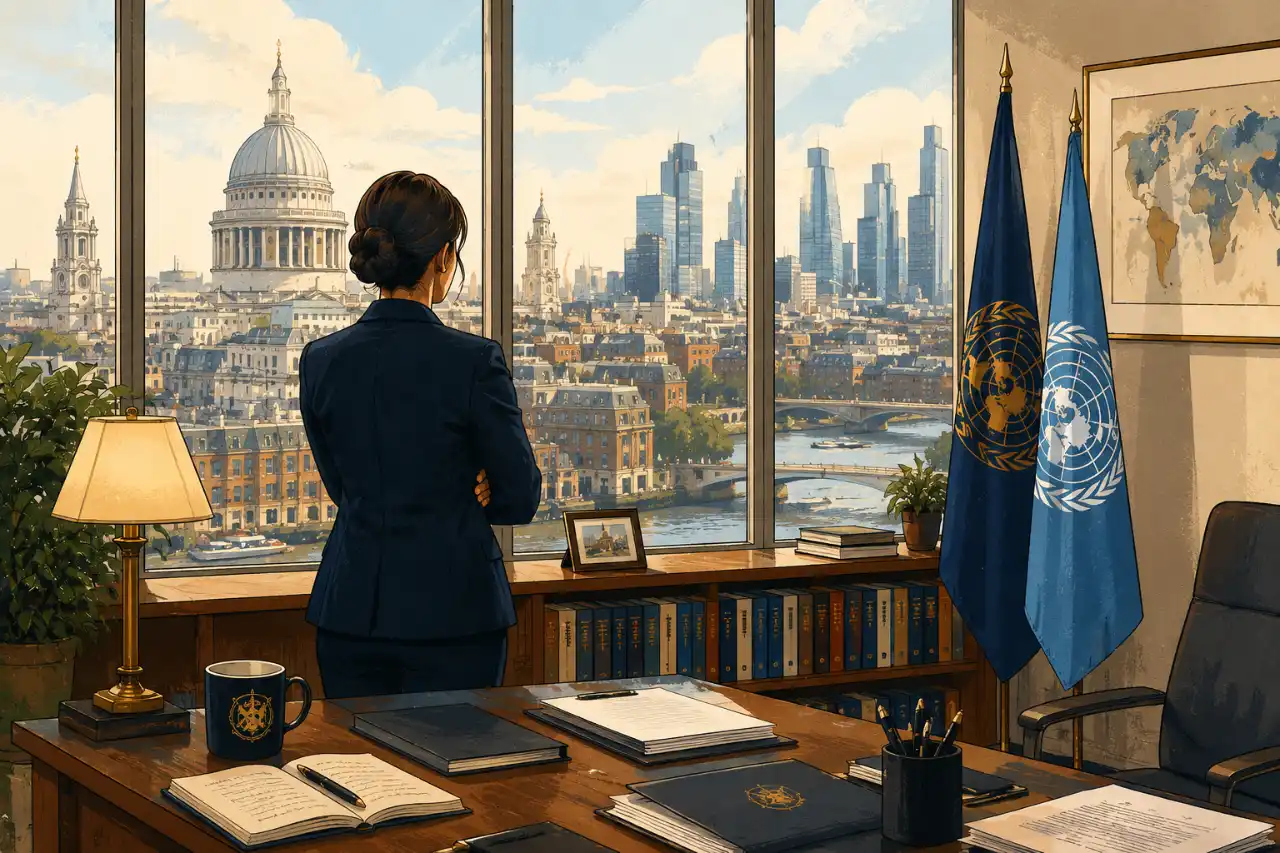

To many the diplomat has a familiar image.
A carefully dressed official moves between embassies and formal receptions, delivers messages on behalf of a government and spends long evenings negotiating behind closed doors. There are motorcades, state dinners, official communiqués and conversations conducted far from public view.
Many aspects of that world still exists.
But in the era of modern diplomacy, the diplomat is increasingly operating in a much larger world.
Today, a diplomat may spend the morning discussing regional security with government officials, the afternoon meeting technology executives and the evening monitoring an online political controversy that could become a foreign-policy problem before the next morning.
The profession has not abandoned its traditional purpose. Diplomats still represent governments, negotiate, gather information, protect national interests and build relationships abroad.
What has changed is almost everything surrounding that work.
Diplomacy is no longer only government to government
Traditional diplomacy was built largely around relationships between states.
Those relationships remain at its centre, but many of the issues governments now confront cannot be understood by speaking to other governments alone.
Technology companies control platforms used by billions of people and Multinational corporations manage supply chains larger than the economies of some countries while universities conduct strategically important research and humanitarian organisations operate in conflicts where governments have limited access. Many cities are developing their own international relationships around climate, investment and migration.
A diplomat trying to understand another country may therefore need relationships with business leaders, journalists, academics, civil society organisations, scientists and local communities as well as politicians.
This is especially important because foreign policy itself has expanded.
Diplomats are now expected to understand issues ranging from artificial intelligence and cybersecurity to critical minerals, climate change, energy security and global health.
The subjects sitting on the diplomatic table increasingly resemble the subjects shaping everyday life.
The information problem has changed
There was a time when an embassy could provide its government with information that was difficult to obtain from thousands of kilometres away.
That advantage has changed dramatically.
A political speech in another country can now be watched live from a phone, election results arrive instantly, satellite images circulate online, journalists, researchers and ordinary citizens document events as they happen.
Foreign ministries have access to more information than diplomats of previous generations could have imagined.
The challenge is deciding what to trust.
Research on digital diplomacy in 2026 describes foreign ministries operating in an environment of enormous information volume, artificial intelligence, online manipulation and rapidly moving digital narratives. Technology can help diplomats monitor events, translate information and search enormous quantities of material, but human judgement remains essential. (diplomats.digital)
A diplomat on the ground still possesses something difficult to reproduce from headquarters: context.
Knowing that a minister made a speech is one thing.
Knowing whether people inside that country believe the minister, whether business leaders are worried, whether another government is quietly unhappy or whether the public mood is beginning to change is something else.
Modern diplomacy therefore requires an unusual combination of old and new skills.
The diplomat needs digital awareness, but also the ability to sit across a table from someone and listen.
The public can now watch
Diplomacy has also become considerably more visible.
Embassies and foreign ministries maintain social-media accounts. Ambassadors give interviews, publish commentary and communicate directly with foreign publics. A diplomatic statement can be shared around the world within minutes.
That visibility creates opportunities.
A country no longer needs to rely entirely on another country’s media or government to explain its position. Its diplomats can speak directly to people.
But the same environment creates risk.
A poorly worded post can become an international controversy. False information can spread before an embassy has established what happened. An edited video or fabricated image can create political pressure while officials are still trying to verify it.
The modern diplomat therefore has to understand communication in a way previous generations did not.
Sometimes saying something quickly matters.
Sometimes resisting the pressure to say anything at all is the wiser diplomatic act.
Technology has become foreign policy
Perhaps the biggest change is that technology is no longer simply something diplomats use.
It is something they negotiate.
Governments are trying to establish rules around artificial intelligence, cybersecurity, data, digital trade and telecommunications infrastructure. Technology companies increasingly find themselves involved in questions once considered the exclusive territory of states.
The 2026 State of Digital Diplomacy report argues that diplomatic institutions are moving beyond treating digital diplomacy as simply social-media communication. Digital systems increasingly affect crisis management, information gathering, consular work, negotiations and the internal operation of foreign ministries themselves. (diplomats.digital)
Artificial intelligence adds another layer.
AI can assist with translation, research, monitoring and drafting. But diplomatic institutions must also consider confidentiality, misinformation, reliability and whether sensitive decisions are becoming too dependent upon systems they do not fully control. (diplomats.digital)
The technology may be new.
The diplomatic problem is surprisingly old: whom do you trust?
The room still matters
For all this change, it would be a mistake to imagine that diplomacy is becoming entirely digital.
A video call can transmit words but it cannot always create trust.
Some negotiations require conversations that are deliberately kept away from cameras. A mediator may need to understand hesitation, body language or what someone refuses to say. Governments sometimes communicate through intermediaries precisely because direct public negotiation is politically impossible.
This is why countries continue to maintain embassies and diplomatic missions even in an age when leaders can communicate instantly.
Relationships remain infrastructure.
A diplomat who has spent years developing contacts may be able to make a telephone call during a crisis that someone without those relationships cannot.
And sometimes diplomacy depends upon precisely that call.
A different kind of diplomat
The profession is therefore becoming broader rather than obsolete.
The successful diplomat of the future may need the political instincts traditionally associated with the profession, but also some understanding of technology, economics, climate, communications and data.
They must be able to operate publicly while knowing when discretion is necessary.
They must understand what is happening online without mistaking the internet for an entire society.
They must represent their government’s interests while developing enough trust with others to hear things that will never appear in an official statement.
And they must process an extraordinary amount of information without allowing speed to replace judgement.
In that sense, modern diplomacy may be changing less than it appears.
Its tools are different. Its subjects are broader. Its audiences are larger and the pace is considerably faster.
But underneath all of it remains something remarkably human.
Governments still need people who can enter a room, understand what others want, recognise what their own country can realistically achieve and find the small areas where competing interests might overlap.
The smartphone may now sit beside the diplomatic cable.
The fundamental skill remains knowing whom to call, and what to say when they answer. As the nature of international relations continues to transform, The Western Diplomat will continue to provide critical insights into how modern diplomacy reshapes modern statecraft.



[…] The Diplomat Is Changing: What Does Modern Diplomacy Actually Look Like? […]