

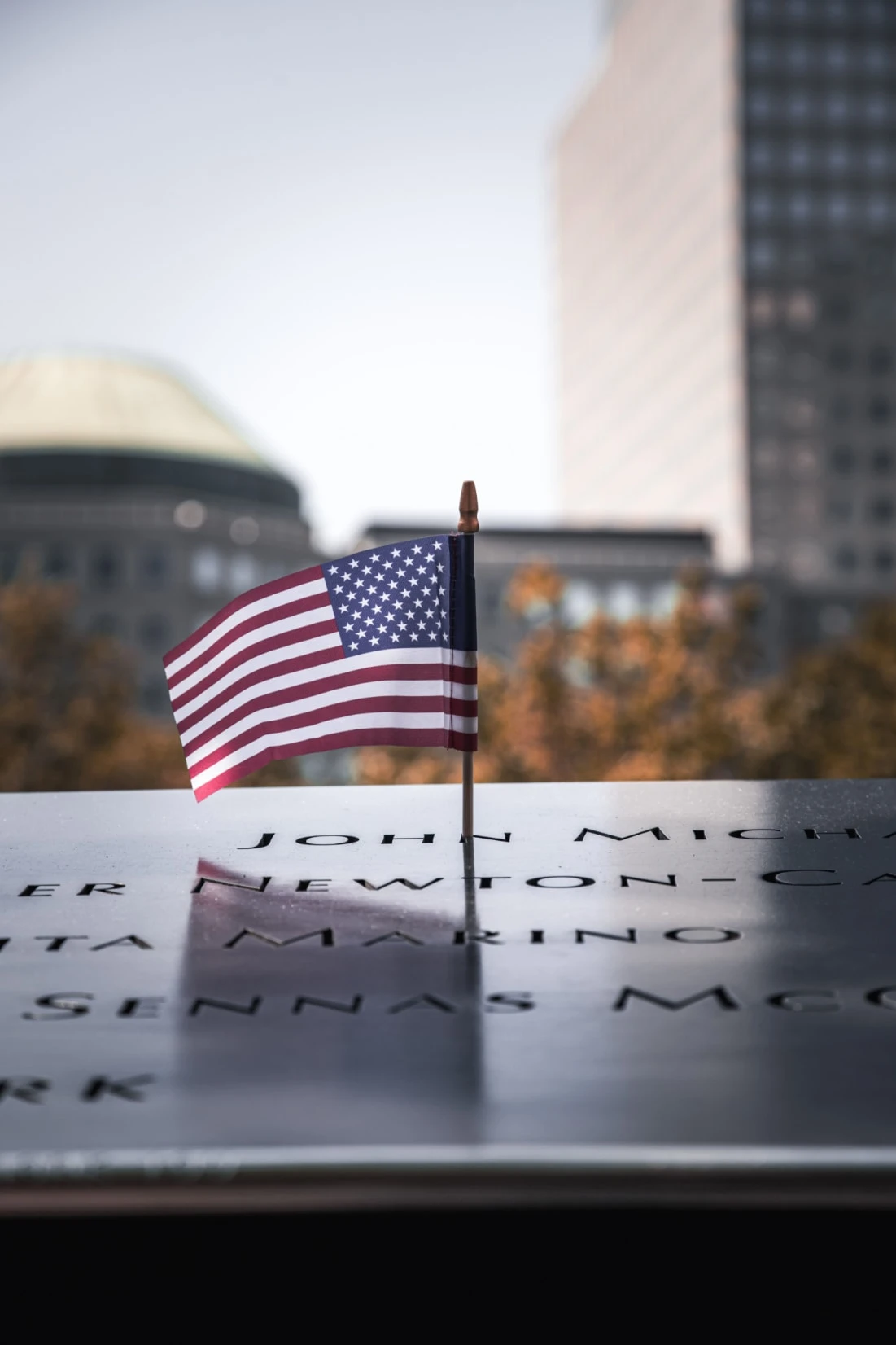

Subtitle: On September 11, America remembers its fallen citizens, and the resilience that has carried a nation through its darkest hours.
There are some dates that are forever etched in our collective memory, never to be erased.
September 11 is one of them.
Twenty-five years ago today, ordinary people began an ordinary Tuesday morning. They went to work, boarded airplanes, poured coffee, kissed spouses goodbye, dropped children off and hurried through the familiar rhythms of everyday life.
By the end of that morning, 2,977 lives had been lost in terrorist attacks in New York, at the Pentagon and aboard Flight 93 in Pennsylvania. Thousands more were injured, while families across America and beyond were suddenly confronted with an unimaginable new reality, a life divided between everything that existed before that morning and everything that would come after it.
Today, on this September 11 Anniversary, their names are deeply remembered again at official tributes like the 9/11 Memorial & Museum.
Twenty-five years is enough time for a child to become an adult, enough time for buildings to rise where ruins once stood and enough time for a generation to have been born with no memory of watching the towers fall.
But passing time will never be enough to make grief disappear.
Reflecting on the September 11 Anniversary and American Resilience
September 11 is a reminder of a harsh reality of the world we live in, but it is also a story of the hope and resilience of a nation and its people. When we look a little closer, this loss becomes part of a much longer American story, one not simply about tragedy, but about rebuilding from the ground up when the future people once imagined is suddenly destroyed.
You see, America has been here before.
Not in precisely the same circumstances of course, History does not repeat itself in exactly the same way, but there has definitely been periods and seasons off uncertainty and profound loss for the nation. History tells of a time when Americans were not certain there would continue to be a United States at all.
By the time Abraham Lincoln took office in 1861, states were leaving the Union and the country was descending into civil war, dividing families and communities as Americans found themselves fighting one another in a conflict that would ultimately claim hundreds of thousands of lives.
Lincoln would not live to see much of the peace that followed. Just days after the war was effectively drawing to a close, he was assassinated.
A country exhausted by death lost the president who had guided it through the crisis.
And still, morning came.
That may be one of history’s simplest and at the same time, most difficult lessons.
Morning comes.
People may grieve for a long time because there are some things that simply cannot be repaired, sometimes morning arrives while people are still standing among the ruins, wondering what could possibly come next.
The answer is usually that someone gets up and begins. Someone clears the rubble while another opens a business; someone returns to school, raises a child, runs for office, invents something new or simply plants again.
Eventually, these acts of continuation come together to tell the story of a society rebuilding itself.
America would experience that cycle many times.
Industrialisation transformed the country, but it also brought dangerous factories, brutal working conditions, inequality and upheaval as millions adjusted to a new economic order. Cities expanded to accommodate growing industries, while labour movements fought for greater protections and fairness in a rapidly changing economy. New technologies emerged at remarkable speed, fundamentally altering the ways people worked and lived.
Then came economic catastrophe.
The Great Depression devastated families, wiped away fortunes, shuttered businesses and left millions without work. The confidence of one of the world’s fastest-growing economies was shaken profoundly.
But still, Americans continued.
Institutions changed, new protections emerged and infrastructure was built as people found ways to endure and rebuild through years of hardship they could never have anticipated when prosperity had once seemed permanent.
Then came war again.
Pearl Harbor brought another morning of shock and loss. The Second World War demanded sacrifices from families across the country. Americans went overseas and many never returned. Those at home entered factories, rationed supplies and reorganised ordinary life around a conflict whose outcome was not predetermined.
The country that emerged from that period was changed.
That is an important part of resilience that can sometimes be lost when we turn history into inspirational stories.
To recover is not necessarily to return to who you were before.
Sometimes you simply cannot.
September 11 changed America permanently.
It changed airport security and government institutions. It transformed foreign policy and America’s understanding of its own vulnerability. It sent young Americans to wars overseas, profoundly altering their futures. Muslim Americans and others endured suspicion and prejudice in the fear that followed. First responders and recovery workers continued to suffer illnesses years after the debris had been cleared.
Resilience does not require us to pretend those consequences did not exist just as patriotism doesn’t require us to believe that every decision made in the aftermath of tragedy was correct.
A country can honour its strength while learning from its mistakes.In fact, perhaps that is another form of strength.
What deserves remembering about September 11 is not only what was destroyed, but what people did in the face of such unimaginable tragedy. Brave firefighters climbed the stairs while others were running down them, as police officers, paramedics and ordinary citizens moved towards danger to help those in need. Passengers aboard Flight 93, having learned what was happening elsewhere, fought back against their hijackers, while volunteers from every imaginable background came forward to assist with rescue and recovery efforts, providing food, supplies, comfort and support wherever they could.
Strangers cared for strangers, and the courage displayed that day emerged in ways that could never have been anticipated. It remains a lasting testament to the extraordinary strength and heart that ordinary people can find within themselves when faced with the unimaginable.
This truly speaks to the grit of people, because nations do not possess resilience independently of the human beings who inhabit them. A flag cannot rebuild a city; it is the people who do. And Americans would be asked to demonstrate that capacity again and again.
The financial crisis of 2008 brought another kind of fear, as homes were lost, businesses failed and retirement accounts collapsed. Families who had done everything they believed they were supposed to do discovered just how quickly financial security could disappear.
The country staggered, but all was not lost. America got up once again.
Then, in 2020, along with the rest of the world, America encountered an enemy that could not be seen approaching on an aircraft or confronted on a battlefield. COVID-19 emptied streets, closed schools and businesses, separated families and filled hospitals. Weddings were postponed, funerals were restricted, grandparents met grandchildren through windows, and healthcare workers walked into exhausting shifts while much of the world stayed home. Hundreds of thousands of American lives would ultimately be lost during the pandemic.
Again, society changed, and again, it continued moving forward.
There is something deeply human in that pattern, and it reaches far beyond the United States, deeply impacting international policy and global affairs.
Every society knows loss.
Human history is filled with endings that somehow failed to become the end.
Perhaps that is why America’s particular attachment to resilience resonates so strongly within its national identity. American patriotism can be loud. It appears in flags hanging from porches, national anthems before sporting events and a stubborn belief in the possibility of beginning again.
Sometimes others misunderstand that confidence. But there is evidence to suggest that beneath the spectacle is something more intimate.
The American story has never been one uninterrupted march toward prosperity. It has included civil war, assassination, economic depression, terrorism, racial injustice, natural disasters, disease, political turmoil and periods in which the country’s own people profoundly disagreed about what America should become.
But America still stands today a proud nation, A nation that has so far survived 100% of its bad and scary days.
That’s especially important to remember on days like today, the anniversary of September 11.
For those who lost someone that morning, national resilience cannot replace a person.
A rebuilt skyline cannot return a parent and a memorial cannot restore a spouse.
Twenty-five years cannot give someone back the years they should have had with a brother, sister, child or friend.
There should be room today for that grief without demanding that it become inspirational.
But continuation does not dishonour grief. Sometimes it is how we carry or even honor it.
A person can miss someone terribly and still laugh again. Families can preserve an empty space in its history while making room for new people and new memories. A city can build something beautiful where something terrible happened without pretending the terrible thing did not happen.
And a nation can remember its darkest mornings without allowing darkness to become its entire identity.
Isn’t that is what resilience really means? It is the decision to continue building while remembering what was lost.
Today, the names will be spoken.
Families will remember voices that the rest of the world never knew. Photographs will appear again of people frozen forever at the age they were in 2001. Firefighters will remember colleagues. Children who grew up without parents will stand as adults. A nation will look backwards.
And tomorrow morning, across America, people will return to work, children will make their way to school, planes will cross the skies, and businesses will open their doors. Construction crews will arrive at their worksites, entrepreneurs will take the first steps toward building something new, and somewhere, two people will fall in love while countless others make plans for futures they have yet to experience. In these ordinary moments, life will continue as it has through some of humanity’s darkest chapters, carried forward by the enduring human capacity to hope, rebuild and find purpose even in the aftermath of unimaginable loss.
Perhaps this is the courage worth remembering each September 11: not the expectation that a nation should never stumble or that its people should somehow become immune to grief, but the quieter, more demanding courage that Americans have demonstrated across generations. It is the willingness to rise after devastation, to embrace possibility despite uncertainty, and to keep building a future even when the weight of the past remains. Above all, it is the courage to continue.