

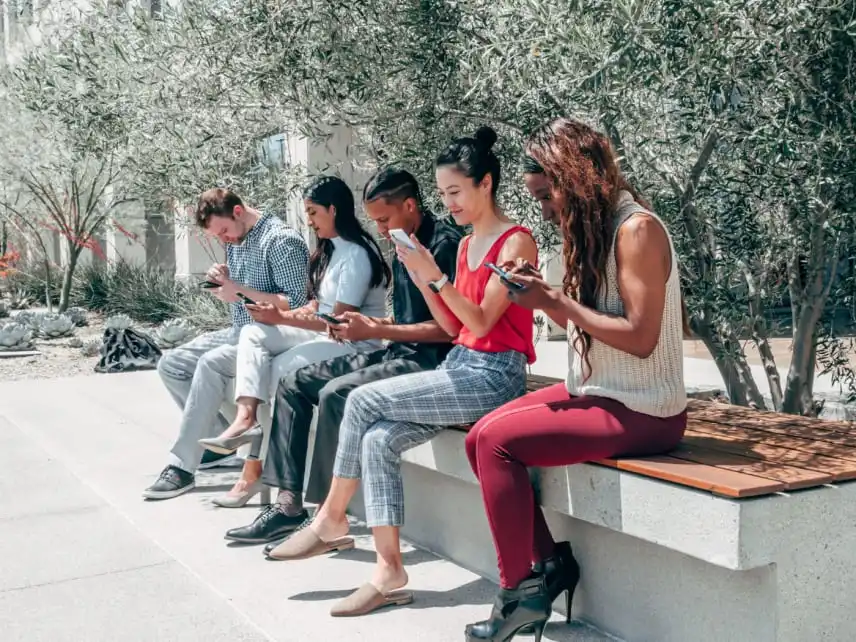

A generation raised online is beginning to question social media, its impact on self-image, and the endless cycle of digital comparison.
There was a time when we mostly compared ourselves with the people around us. Understanding the full social media impact on daily life reveals how deeply human comparison has changed over time.
Maybe there was the beautiful girl at school, the athletic boy everyone had a crush on, the impossibly glamorous celebrity on television or the model staring back from the cover of a magazine. There were always people who seemed prettier, richer, thinner, cooler or more confident.
But eventually, you could put the magazine down.
Social media changed the scale of comparison completely.
For a generation raised online, there is always another face to admire, another lifestyle to envy, and another seemingly perfect existence against which to measure their own. Social media presents an endless procession of beautiful bodies, extravagant wardrobes and luxurious holidays that can leave the average person questioning the value of their own accomplishments.
Influencers document elaborate morning routines beginning at 5:00 a.m., green smoothies in hand, against the backdrop of immaculately designed apartments that resemble art galleries or luxury hotels more than ordinary homes.
Together, these carefully curated glimpses into other people’s lives create a world in which even the most mundane aspects of daily existence appear to demand an extraordinary level of perfection.
What makes this constant exposure concerning is its accessibility. These carefully curated images of wealth, beauty and seemingly effortless success are no longer only in magazines, television screens.
They are available to anyone with a smartphone, at any hour of the day, placing an endless stream of idealised lifestyles quite literally at our fingertips.
Social media has given us extraordinary things. It has allowed friendships to survive across oceans, helped small businesses find customers and given artists, writers and ordinary people access to audiences that previous generations could hardly have imagined.
It has created communities for people who once felt alone and introduced us to cultures, lifestyles and ideas we may never have encountered otherwise.
But after growing up inside this enormous digital experiment, younger generations are beginning to ask an uncomfortable question.
What is all this access doing to the way we perceive life and see ourselves?
Of course, beauty standards existed long before Instagram. Human beings have been altering their appearances, following fashion trends and comparing themselves with one another for centuries. Social media did not invent insecurity.
What it did was make comparison almost limitless.
A young woman no longer compares herself only with women in her community. Before breakfast, she can see a fitness influencer in Los Angeles, a model in Paris, a beauty creator in Seoul and someone her own age vacationing in Bali.
Then comes the algorithm.
Watch enough fitness content and suddenly everyone seems to have the perfect body. Pause on a luxury handbag, and before long your social media feed begins to suggest that you are perhaps the only person in the world who doesn’t own one.
Spend a little time exploring cosmetic procedures, and even a perfectly ordinary face can start to resemble a collection of flaws in urgent need of correction.
Conveniently, the algorithm is always prepared with a seemingly endless selection of treatments, specialists and clinics to help you address problems you may never have considered having in the first place.
The strangest part is that we know much of what we are seeing isn’t entirely real.
We know that photographs can be edited, that lighting and camera angles can dramatically influence appearances, and that the perfect image we see online may have been selected from twenty less flattering attempts.
Modern filters can smooth skin, alter proportions and transform facial features almost beyond recognition. Most of us have spent enough time on social media to understand that what appears on our screens is often a carefully curated version of reality.
After all, influencers are hardly rushing to share photographs of themselves hunched over the kitchen counter at 11 p.m., exhausted and irritable, eating cereal straight from the box.
Yet despite knowing how much of what we see is staged, edited or selectively presented, we can still find ourselves measuring our ordinary, unfiltered lives against it.
Turns out knowing something intellectually does not necessarily prevent us from feeling it emotionally.
You can know that a photograph is filtered and still wonder why your skin doesn’t look like that. Knowing that someone’s body represents genetics, posing, lighting, and perhaps cosmetic intervention does not shield a person from looking at their own reflection differently afterwards, just as understanding perfectly well that someone’s luxurious online life represents a carefully selected fraction of their reality, still may not stop a person from wondering why their own days feel so painfully ordinary.
This is one of social media’s most peculiar effects. We compare the full, unedited experience of our own lives with the edited highlights of everyone else’s.
That creates an unusual problem for a generation developing its sense of self, while simultaneously possessing the technology to digitally redesign that self.
That said, social media’s relationship with body image and lifestyle isn’t entirely negative. Analyzing the positive aspects of social media impact reveals how platforms also offer constructive spaces.
The same platforms that circulate narrow beauty ideals have also helped challenge them.
Body types that were historically absent from fashion magazines and mainstream advertising have become increasingly visible. Women show stretch marks, cellulite, scars, and stomach rolls. We’ve seen Disabled creators build enormous audiences. People are documenting acne instead of hiding it, different skin tones, hairstyles, and ideas of beauty have found communities willing to celebrate them.
For every corner of the internet insisting that we need to become smaller, smoother or younger, another is beginning to offer a different message: perhaps we are perfectly fine as we are. This growing shift in perspective may help explain why people around the world are not only questioning the unrealistic standards promoted on social media, but also making a conscious effort to reject the endless cycle of comparison. Conversations around self-love, body positivity and self-acceptance are gaining visibility, encouraging people to reconsider the idea that their worth should be measured against someone else’s appearance, lifestyle or carefully curated version of success.
Understanding Social Media Impact on Mental Health and Youth Culture
The generation raised online is not necessarily rejecting social media but.. some are definitely becoming more literate about it.
People joke about deleting apps for their mental health. They unfollow accounts that make them feel terrible about themselves and screen-time limits have become a form of self-discipline.
“Photo dumps” sometimes favour messy, ordinary photographs over meticulously crafted feeds. There is renewed affection for analogue hobbies, physical books, film cameras, crafts and experiences that don’t necessarily need to become content.
Even the idea of privacy has begun to feel luxurious. There is something appealing about having a wonderful day and nobody else knowing about it. Taking a trip to somewhere beautiful or wearing that incredible outfit without feeling the need photograph it.
Are we rediscovering that a life does not become more valuable because more people have seen it?
What may be changing is our understanding of how wonderful it is to live in the moment and give our attention to the more wholesome things in life. After all, attention shapes perception.
What we look at repeatedly can influence what begins to feel normal, desirable or expected. If your screen constantly presents extraordinary bodies, extraordinary wealth, extraordinary beauty and extraordinary lifestyles, ordinary life can start to look like failure.
But ordinary life is where most of us actually live and find the most joy. There is something wonderfully freeing about remembering that.
Perhaps the next evolution of social media will not be defined by another technological breakthrough, but by our growing ability to become harder to impress and more content with the lives we already have.
A generation raised online may gradually become more skilled at recognising the performance behind the perfection, less susceptible to the exhausting cycle of comparison, and more aware that genuine confidence cannot be built entirely upon the approval of an audience.
Perhaps we will also become better at looking in the mirror without wondering how the person staring back might appear through a filter, choosing instead to appreciate the features, imperfections and individuality that make us who we are.
And if that appreciation continues to grow, we may find ourselves moving towards a society that no longer treats difference as something to correct, but as something to celebrate.
A world in which beauty is not confined to a narrow ideal, and where the extraordinary diversity of the human race is met with greater kindness, acceptance and admiration, as highlighted in ongoing global discussions on social policy.
To learn more about digital well-being and managing online screen time, explore the official resources at MentalHealth.gov.