

Diplomacy was once easily imagined.
Ambassadors met behind closed doors and Governments negotiated treaties. Foreign ministers travelled between capitals while questions of trade and business were largely left to economists, companies and finance ministries.
In recent times that distinction has become blurred, giving rise to a new era of economic diplomacy that is increasingly difficult to ignore.
Today, a semiconductor factory can carry almost as much strategic importance as a military base. A tariff can become an instrument of political pressure. Access to critical minerals can influence negotiations between governments, while a billion-dollar infrastructure investment can establish relationships that last for decades.
Trade has always influenced foreign policy. What has changed is the extent to which governments are deliberately using economic relationships to pursue strategic goals.
We are entering an age of economic diplomacy and the shift is visible almost everywhere.
The United States has increasingly used tariffs, sanctions and access to its enormous consumer market as tools of foreign policy. China has spent years developing economic relationships through trade, infrastructure and investment across Asia, Africa, Latin America and the Pacific. The European Union is becoming more protective of industries it considers strategically important.
Governments that once pursued globalisation primarily through the language of efficiency are now talking about resilience, economic security and strategic industries. The question is no longer simply where something can be produced most cheaply. It is of equal or even greater importance to assess whether its access can still be relied upon during a crisis.
Few industries demonstrate this better than semiconductors.
The tiny chips found inside phones, vehicles, medical equipment, weapons systems and artificial intelligence infrastructure have become strategically important assets. Their production is concentrated among a relatively small number of countries and companies.
As a result, governments are spending billions attempting to secure semiconductor supply chains, attract manufacturing facilities and prevent advanced technology from strengthening potential rivals.
What appears at first to be industrial policy quickly becomes foreign policy.
Critical minerals have followed a similar path.
Modern economies depend upon materials required for batteries, electronics, defence equipment and renewable energy technologies. Countries possessing large reserves of lithium, cobalt, nickel, copper and rare earth elements therefore occupy increasingly important positions in international negotiations.
The countries buying those materials want reliable access.
The countries possessing them increasingly understand their leverage.
This has created opportunities for states that may never possess enormous military power but control resources that larger economies need.
Infrastructure offers another example.
On the surface, financing a railway, port, power plant or telecommunications network is an economic activity. But infrastructure can also build political relationships. This is where economic diplomacy plays a crucial role in modern geopolitics.
China’s overseas infrastructure investments demonstrated this on an enormous scale. Through the Belt and Road Initiative, Beijing financed projects across developing economies while expanding commercial and diplomatic relationships far beyond East Asia.
Western governments have increasingly responded with infrastructure and investment initiatives of their own.
In the Pacific, this competition can be seen in places that rarely dominate international headlines.
The United States and New Zealand recently announced funding for an upgrade to a port in the Cook Islands. The project will improve maritime access and support economic activity, but it also comes as Western governments seek stronger relationships across a region where China has steadily expanded its presence.
A port is therefore no longer necessarily just a port.
It can represent access, influence, economic opportunity and a relationship between governments.
The same transformation can be seen in trade agreements.
For decades, trade negotiations were frequently presented as exercises in lowering tariffs and expanding commerce. Today, they increasingly contain conversations about national security, technology, energy, labour standards and supply-chain resilience.
Countries are also reconsidering how dependent they should become upon individual trading partners.
The logic is understandable.
The pandemic demonstrated how quickly global supply chains could be disrupted. Russia’s invasion of Ukraine transformed Europe’s understanding of energy dependence. Competition between the United States and China has raised questions about access to technology and manufacturing. Conflicts affecting major shipping routes have demonstrated the vulnerability of international commerce to events occurring thousands of kilometres away.
Efficiency is still important. But resilience now carries a price governments appear increasingly willing to pay.
This creates a different environment for businesses as well.
Companies deciding where to manufacture can no longer consider labour costs, taxes and transportation alone. They must increasingly think about tariffs, sanctions, political relationships and whether an election could suddenly change the rules governing access to a major market. For global corporations, understanding economic diplomacy is now essential.
Mexico offers a useful example.
Its proximity to the United States and access to the North American market have made it an attractive manufacturing location. Yet uncertainty surrounding the future of the United States-Mexico-Canada trade relationship has recently made some businesses more cautious about new investment.
A diplomatic disagreement can therefore become a boardroom problem remarkably quickly.
For smaller and developing countries, the rise of economic diplomacy creates both opportunity and danger.
A country with critical minerals, strategically located ports, renewable energy potential or access to an important market may find itself courted by competing powers.
That competition can bring investment.
But accepting investment from one partner can sometimes complicate relations with another.
Governments therefore need increasingly sophisticated foreign policies capable of separating economic opportunity from excessive dependence.
The strongest position may not always be choosing one side.
It may be maintaining enough relationships to avoid becoming entirely dependent upon any of them.
There is another consequence.
Economic pressure can sometimes achieve political objectives without a single soldier crossing a border.
Sanctions can restrict access to financial systems. Export controls can prevent countries from obtaining advanced technology. Tariffs can make industries less competitive. Restrictions on critical resources can place enormous pressure on manufacturing.
These measures are attractive because they appear to offer governments something between diplomacy and war.
But they are not without consequences.
Economic pressure can hurt ordinary consumers and businesses far removed from the political dispute that caused it. Sanctions can encourage countries to develop alternative trading systems. Tariffs can provoke retaliation. Attempts to isolate an economy can sometimes strengthen relationships among the countries being isolated.
Economic power is formidable, but it is not unlimited.
Global commerce has repeatedly shown an ability to adapt. Supply chains move. New suppliers emerge. Businesses find alternative markets.
That makes economic diplomacy a balancing act.
Governments want the leverage that comes from controlling markets, technology and resources without destroying the international economic relationships that created that leverage in the first place.
This may be one of the defining challenges of modern foreign policy.
The diplomat of the future will still need to understand politics, history and international law.
But increasingly, diplomacy will also require an understanding of supply chains, artificial intelligence, energy markets, investment and technology.
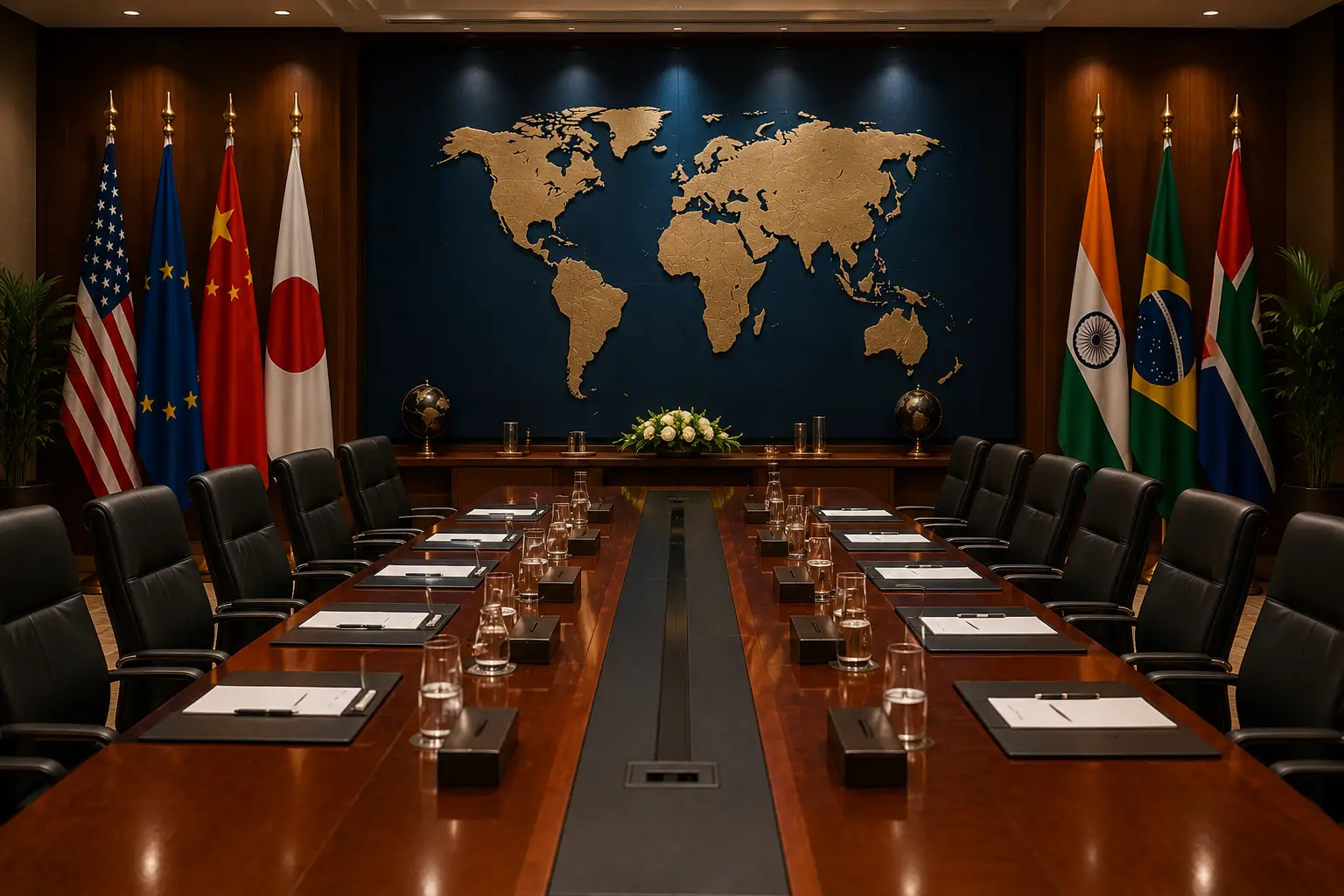
The negotiating table has expanded.
Sitting around it now are not only presidents, ambassadors and foreign ministers, but trade officials, technology companies, investors, energy producers and multinational businesses.
Power has not stopped being military. It has simply acquired more instruments.
And in a world where access to a chip, mineral, market or shipping route can change the calculations of governments, some of the most consequential acts of foreign policy may increasingly look like business deals. As trade policy and geopolitical power continue to align, The Western Diplomat will continue to analyze how economic diplomacy reshapes modern international relations.